
ISO Cleanroom Classifications and What They Mean for Your Cleaning Contract
ISO classification determines the cleaning protocol, materials, and gowning your controlled environment requires. Here is how the levels differ.
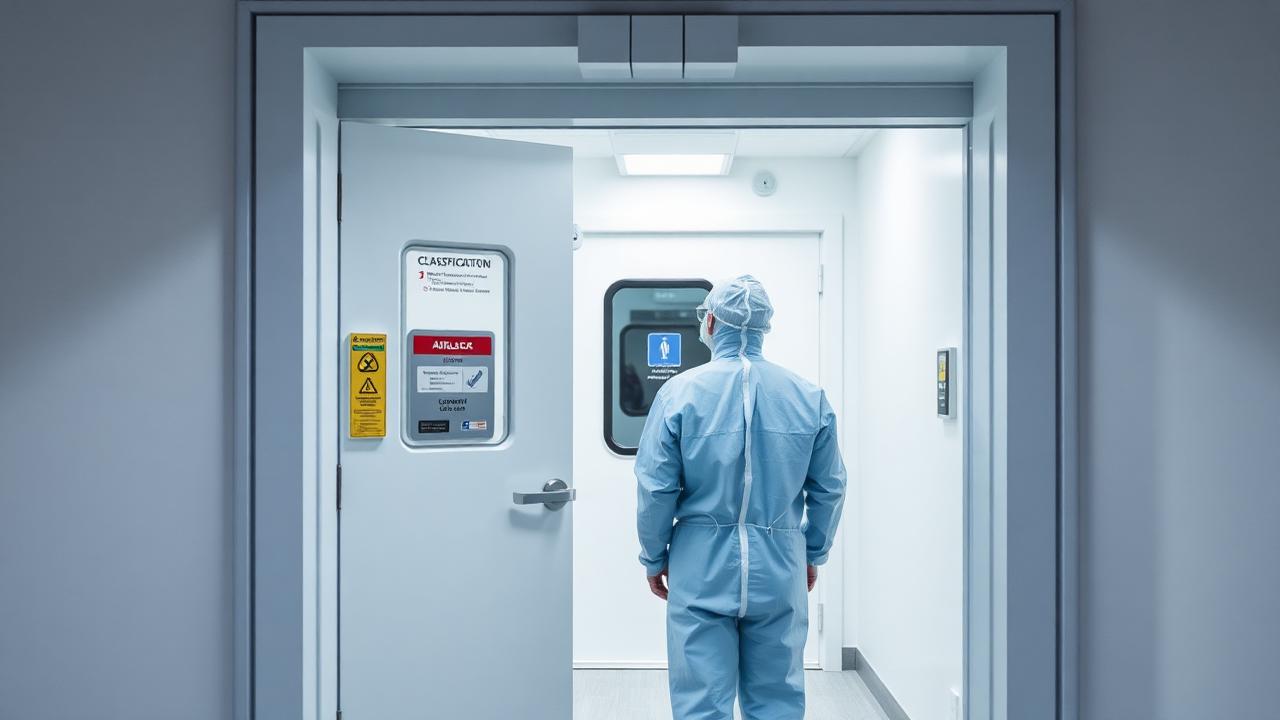
Cleanroom classifications get referenced in contracts more often than they get understood. A facility manager inherits a space described as ISO 7 and reasonably wants to know what that obligates them to, and what a cleaning vendor should be doing differently as a result.
The short version is that classification defines an airborne particle limit, and everything about the cleaning program follows from how difficult that limit is to hold.
What the numbers describe
The ISO 14644 framework classifies controlled environments by the maximum concentration of airborne particles permitted at specified particle sizes, per cubic meter of air. Lower numbers are cleaner. ISO 8 is the least stringent commonly encountered classification, and the scale runs downward through ISO 7, ISO 6, ISO 5, and below into environments used for the most sensitive processes.
Each step down the scale represents a substantial reduction in permitted particle concentration, not an incremental one. That is why the operational difference between adjacent classifications is larger than the numbers suggest.
Classification is also stated with respect to occupancy state, meaning whether the room was measured as built, at rest, or in operation. A room certified at rest is not necessarily holding that classification while people are working in it.
How classification drives the cleaning program
Moving from a less stringent classification to a more stringent one changes several things at once.
The labor implication is significant. Cleaning an ISO 5 space takes materially longer per square foot than an ISO 8 space, and any vendor pricing them similarly has not understood the scope.
Classification is not the whole specification
Two rooms at the same ISO classification can require different cleaning programs depending on what happens inside them. A room supporting sterile processing has microbial control requirements that a room supporting electronics assembly does not. A room with sensitive optics has residue constraints that others do not.
This is why a cleaning specification should state the classification, the occupancy state it must be held in, the process being protected, the approved product list, the required consumables, the frequency by task, and the documentation to be produced. Classification alone leaves too much unspecified.
Adjacent spaces are part of the system
Gowning rooms, airlocks, material pass-throughs, and corridors feeding a controlled environment determine how much contamination arrives at the door. A program that treats the classified space rigorously and the gowning room casually will fight a losing battle against its own transition zone.
Scope should include these areas explicitly, with their own protocol and frequency.
What to ask before signing
Confirm that the vendor has worked at your classification, that they will provide a written procedure specific to your space, that their staff training is documented and available, that their consumables are appropriate to the classification, and that product substitutions go through you rather than around you.
Highland works in controlled environments
We provide lab and cleanroom care across New York City, Westchester, and Long Island for facilities where the cleaning protocol is part of the process rather than an afterthought.
Call 516-361-3511 or request a facility assessment.
Lab & Cleanroom Care
Serving NYC, Westchester, and Long Island. Request an on-site walkthrough and we will put a written scope together for your building.
Cleanroom Cleaning Protocols: Why Standard Janitorial Does Not Transfer
Cleanroom cleaning follows different rules than commercial janitorial. Here is what changes, from materials to sequence to documentation.
ReadCleaning Around Sensitive Equipment: Data Centers, Labs, and Dust Control
Dust is an operational risk in data centers and labs. Here is how cleaning around sensitive equipment differs from standard janitorial work.
Read