Cleanroom Cleaning Protocols: Why Standard Janitorial Does Not Transfer
Cleanroom cleaning follows different rules than commercial janitorial. Here is what changes, from materials to sequence to documentation.
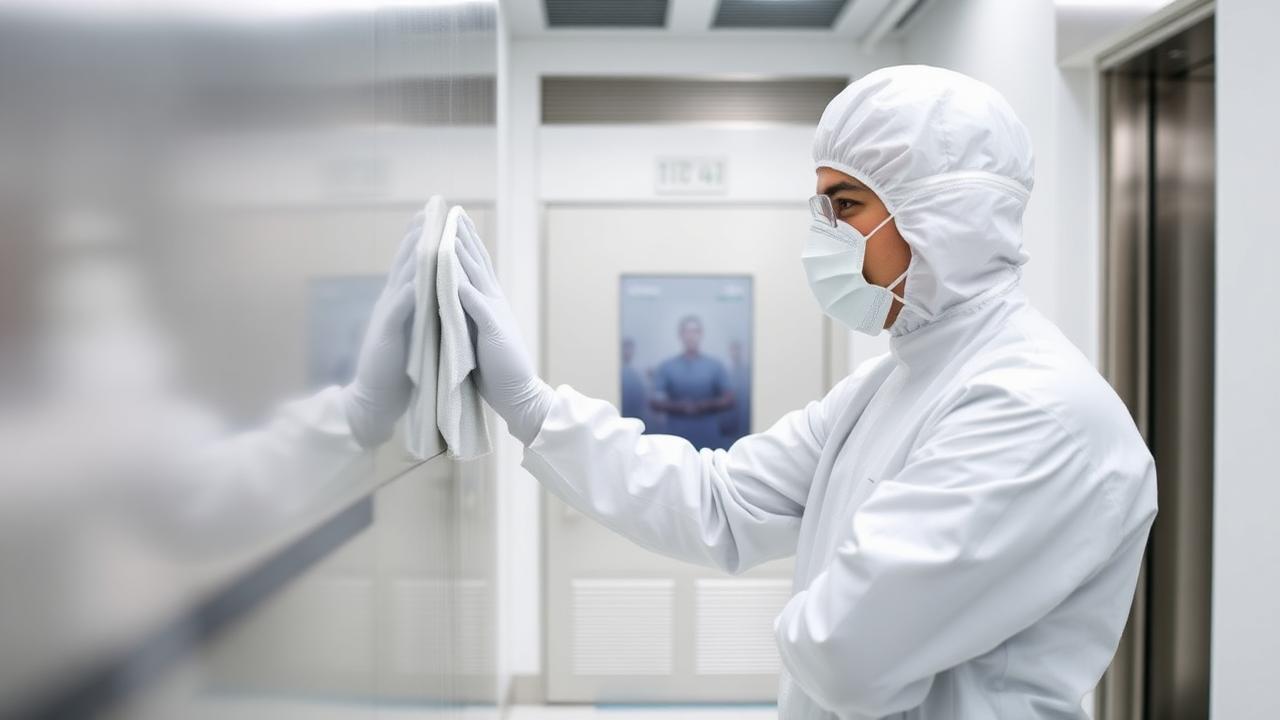
A well-trained commercial cleaner placed in a cleanroom without additional training will contaminate it. Not through carelessness, but because nearly every habit that makes someone effective in an office building is wrong in a controlled environment.
Understanding why is useful whether you manage a cleanroom or are evaluating a vendor who claims to be able to service one.
The objective is different
Commercial cleaning removes visible soil and reduces microbial load on surfaces. Cleanroom cleaning controls particulate. The target is often material that cannot be seen at all, and the measure of success is a particle count rather than an appearance standard.
That reframing changes everything downstream. Activity that looks like cleaning but generates or redistributes particulate is counterproductive, regardless of how good the surface looks afterward.
Materials are part of the protocol
Standard cleaning materials shed. Cotton and conventional paper products release fibers continuously. Ordinary mop heads and cloths introduce more particulate than they remove.
Controlled environments require low-linting or non-shedding wipers, cleanroom-rated mopping systems, and consumables selected and often packaged for the classification. Even documentation materials matter, which is why cleanroom paper and pens exist as separate product categories.
Gowning and personnel flow
People are the largest particulate source in any cleanroom. Gowning requirements exist to contain that, and the requirements vary by classification, from basic coats and shoe covers up to full coveralls with hoods, boots, and gloves.
Gowning sequence matters and is trainable. So is movement discipline. Rapid motion generates particulate. Cleaning staff in a controlled environment work deliberately, which is the opposite of the efficiency instinct that serves them everywhere else.
Sequence and direction
Cleanroom cleaning proceeds from the cleanest area toward the least clean, and generally from the top of the room downward, so that any dislodged particulate settles onto surfaces not yet addressed.
Wiping technique is specified rather than intuitive. Overlapping unidirectional strokes with a folded wiper, with a fresh surface presented on each pass, prevents redistribution. Circular wiping, which is what everyone does naturally, redistributes.
In rooms with unidirectional airflow, work is generally performed in a manner that respects the airflow direction rather than working against it.
Chemistry and residue
Product selection accounts for residue, compatibility with surfaces and equipment, and in many facilities a rotation between disinfectant classes. Sterile or filtered solutions may be required depending on the environment.
Residue that would be invisible and harmless in an office can interfere with processes or instrumentation. This is why product substitution in a controlled environment is a change control matter, not a purchasing decision.
Documentation is the deliverable
In a regulated environment, cleaning that is not documented did not happen. Records should establish what was cleaned, when, by whom, with which product from which lot, at what dilution, and for what contact time. Training records for each person entering the space are part of the same file.
Facilities should expect to review and retain these records rather than trusting that the vendor has them somewhere.
Evaluating a vendor
Highland services controlled environments
We provide lab and cleanroom care for laboratories, controlled environments, and facilities with sensitive equipment across New York City, Westchester, and Long Island, with protocols written for the space rather than adapted from a commercial scope.
Call 516-361-3511 or request a facility walkthrough.
Lab & Cleanroom Care
Serving NYC, Westchester, and Long Island. Request an on-site walkthrough and we will put a written scope together for your building.
Cleaning Around Sensitive Equipment: Data Centers, Labs, and Dust Control
Dust is an operational risk in data centers and labs. Here is how cleaning around sensitive equipment differs from standard janitorial work.
ReadISO Cleanroom Classifications and What They Mean for Your Cleaning Contract
ISO classification determines the cleaning protocol, materials, and gowning your controlled environment requires. Here is how the levels differ.
Read